
Following the Federal Reserve meeting last week and the 25 basis point rate hike announced, we found it timely to compare the two most common ways to hedge a floating-rate loan against future rate increases. Even though the Fed has just raised rates, the market is still pricing in a high probability of another three or four rate hikes by the end of next summer. For our clients with actionable floating-rate debt terms, the question has not been whether to hedge, since most lenders require it, but how to protect against higher rates without giving up the benefit of lower rates in a potential recessionary period during the loan term. This comparison shows how a swap and a cap handle that tradeoff and why the right structure can preserve meaningful cash flow and exit flexibility.
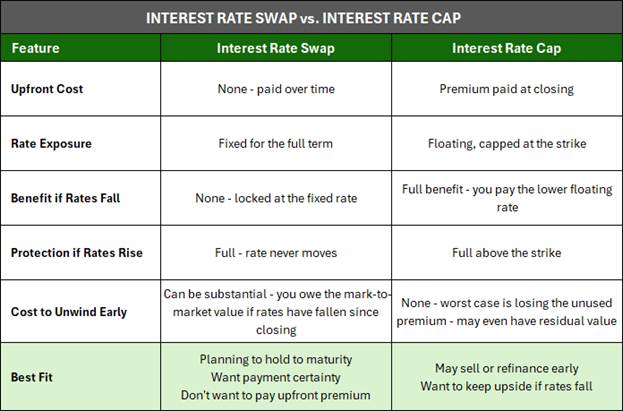
Interest Rate Swap – A swap converts the SOFR portion of your floating-rate loan into a fixed rate for the life of the loan. Your lender’s credit spread (2.50% in the example herein) would remain additive to that fixed-rate index. Because the swap is priced “at the market” when the loan closes, there is no upfront premium.
With an interest rate swap, you are essentially paying for an interest rate hedge over time via a higher (at least initially) interest rate. The more positively steep the forward SOFR curve (as it is right now), the greater the premium to lock in a fixed rate. For example, a loan priced at SOFR+250 basis points today would float at 6.39% (3.89% + 2.50%). If you swapped the loan for five years, your fixed rate would be approximately 7.20%, including a hypothetical lender credit charge. Day 1, you would pay an extra 81 bps of interest for the benefit of knowing your rate won’t be anything other than 7.20% for the life of the loan. That spread will diminish over time if SOFR rises alongside predicted Fed rate hikes.
The certainty of swapping to a fixed-rate loan comes with two important disadvantages. First, if SOFR drops, you will not be able to take advantage of a similar drop in your interest rate. Second, if rates drop and you want to refinance or sell, you will have to pay a swap “breakage” fee (see below, similar in concept to a yield maintenance penalty on a fixed-rate loan, but generally less expensive).
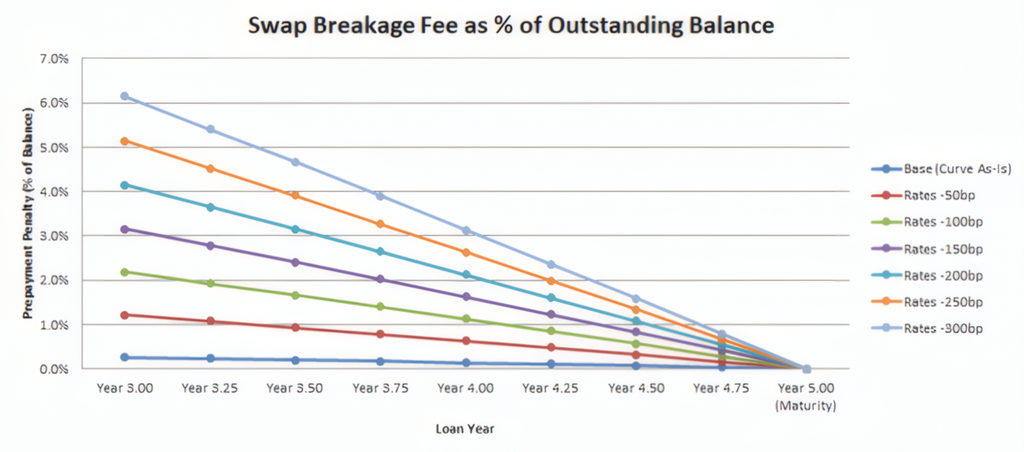
This is where you should ask yourself: why would anyone choose a swap over a cap? After all, who wouldn’t want a lower rate during a recession or the ability to prepay if rates drop?
Interest Rate Cap – You pay an upfront premium to set a ceiling on SOFR. Below the cap strike rate, you keep paying the actual (lower) floating rate; above it, your rate stops rising. You always keep the floating-rate loan; the cap just sits on top of it. And therein lies the biggest disadvantage of a rate cap: the upfront cost. With an interest rate swap, the hedging premium is essentially paid over time.
Why Pay Upfront for a Cap Instead of Over Time for a Swap?
Caps offer more prepayment flexibility, as there is never a related prepayment (breakage fee) penalty. Your underlying loan may have a prepayment penalty; the cap does not add an additional impediment to prepayment.
More importantly (in my opinion), a cap provides the ability to ride SOFR lower if rates drop. In every modern U.S. recession, the Federal Reserve has responded by easing monetary policy and lowering the federal funds rate. Most lenders will implement a SOFR floor, but there is usually considerable room to run before hitting it. During a recession, when property performance is likely to suffer, offsetting lower NOI with lower debt service is a massive benefit.
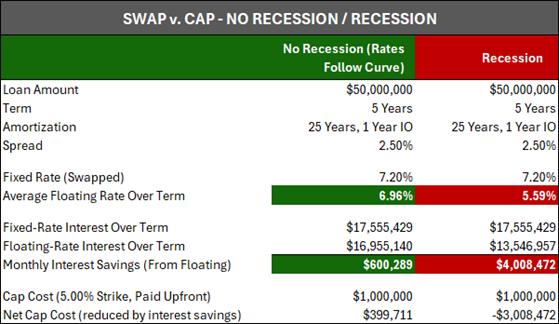
The above scenario compares interest expense over the loan term for a $50 million loan with a floating rate of SOFR+250 basis points as both a 7.20% fixed-rate loan (swapped) and a floating-rate loan with a 5.00% SOFR cap (7.50% maximum interest rate).
If the borrower chooses to float their rate and SOFR follows the curve (assume no major recession), you will save $600k on interest over the loan term (compared to the 7.20% swapped, fixed rate), which offsets 60% of the $1 million upfront cap cost. Not amazing…but not terrible. The $400k of cap premium not offset by interest savings was the net cost of insuring against more extreme rate hikes. After all, insurance is rarely free.
The Potential Payoff
Consider the scenario wherein we enter a recession, beginning in Year 2, the Fed responds by cutting rates 200 basis points over four months, holds steady, and then raises 50 basis points during the final year of the loan term. In this scenario, we are no longer just offsetting part of the cap cost; we are now saving $4.0 million on interest, thus completely covering the cost of the cap and “pocketing” $3 million. The benefit of floating with a cap comes when it is most needed. You have not just hedged for higher rates; you have hedged for a recession. It is worth noting that 200 basis points is the lower end of the 200-500 basis points of cuts in a typical recession-driven tightening cycle.
How to Set Your Interest Rate Cap Strike Rate
The cap strike rate (maximum SOFR rate) is usually dictated by the lender at a level that will assure a targeted DSCR (i.e., 1.35x), assuming NOI remains either at current or a pro forma level, depending on whether it is a stabilized or value-add deal. If the lender is not dictating the cap strike rate, I recommend borrowers resist the urge to minimize the expense by executing a rate cap at a strike rate that is too far out-of-the-money. If rates rise beyond the market’s expectations, you will regret not instituting a conservative rate protection strategy. The cap premium is the only expense on your closing settlement statement that may pay you back (and then some) in the future. One of the easiest ways to pick a cap strike (if not done for you) is to choose a rate not much higher than the equivalent swapped interest rate so you have close to the same rate exposure if rates rise. In the example above, the strike rate is equivalent to 30 basis points above the swapped fixed rate.
Make the Hedge Work for Your Business Plan. The lowest apparent cost at closing is not always the best economic choice over the life of the loan. We model the swap, cap, rate path, exit timing, and downside scenarios together so you can see the real tradeoffs before committing. If you are financing, refinancing, or evaluating an existing floating-rate loan, contact us for a side-by-side hedge analysis built around your property and business plan.
US Hotel Advisors is a service-focused mortgage banking firm. We don’t just arrange loans; we advise where others overlook and advocate for our clients from term sheet to final payoff.